Hair Botox in NYC: Results, Duration, and Added Costs

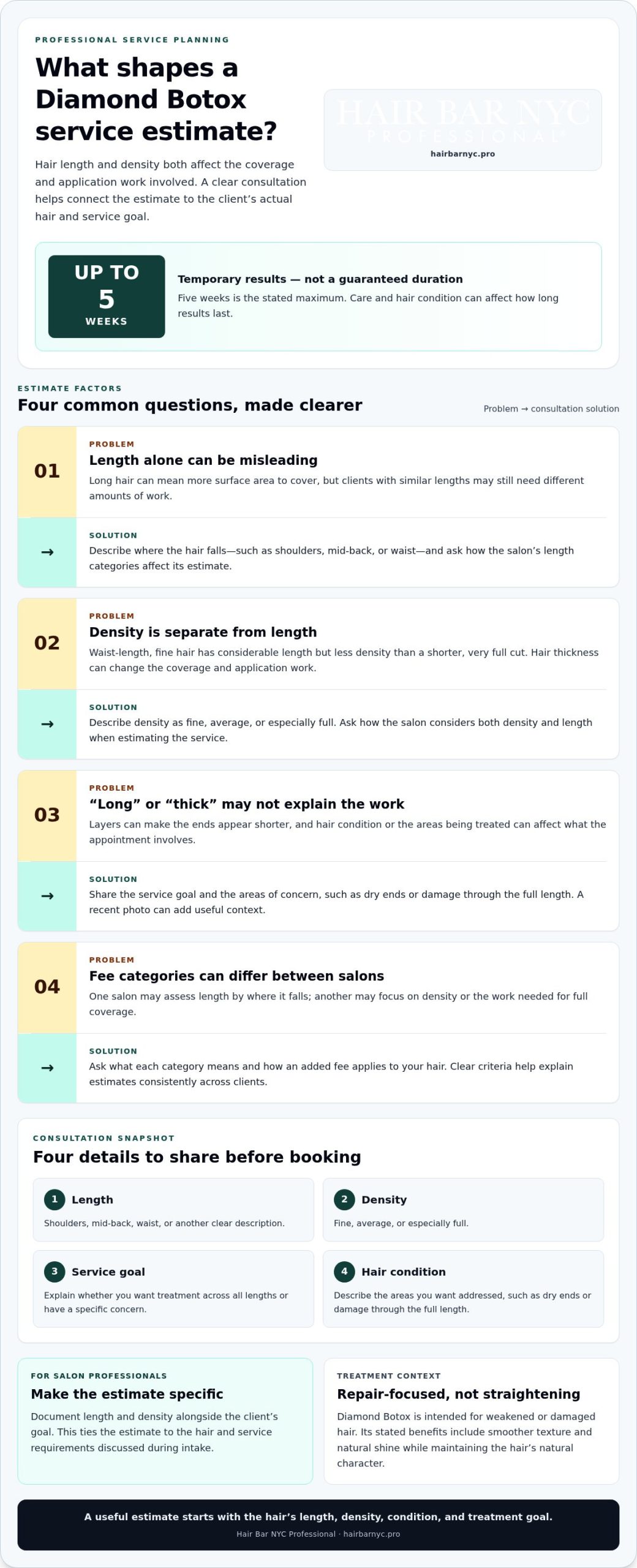
Diamond Botox Hair Repair Therapy results are temporary and can last up to five weeks. This is the stated maximum, not a guaranteed duration for every client, so care and hair condition matter.
Before booking, it helps to know what the treatment is intended to do. Diamond Botox is designed for weakened or damaged hair, aiming to restore elasticity, smooth texture, add natural shine and volume, and promote new hair growth. It is a repair treatment, not a hair-straightening service.
This guide explains what Diamond Botox Hair Repair Therapy involves, what can affect how long results last, and why hair length or thickness may lead to added fees. You’ll also learn what to consider when comparing salon options and how this treatment differs from a smoothing service. With a clear picture of the process and its limits, you can decide whether the treatment aligns with your hair goals and what to expect from your appointment.
Key Takeaways
- Understand what Diamond Botox Hair Repair Therapy is designed to address, including considerations for color-treated or chemically processed hair.
- Learn which hair characteristics may affect added fees and how to factor them into your salon-service planning.
- Explore how to set realistic expectations for maintenance and the treatment’s place in a hair-care routine.
- Know what to consider when comparing NYC salon options, from treatment goals to the appointment experience.
- See how appointment timing can vary and what to discuss when planning your visit.
What is Diamond Botox Hair Repair Therapy?
Diamond Botox Hair Repair Therapy is a cosmetic service intended to revive weakened or damaged hair. Its formula includes conditioning ingredients, and the treatment is designed to improve hair’s appearance and feel.
Hair Types and Treatment Suitability
The treatment is intended for weakened or damaged hair, including hair affected by dryness, dullness from coloring, chemical processing, or frequent heat styling. Thinning hair and loss of tensile strength are also listed concerns. A stylist can review your hair’s condition and service history, then discuss whether this repair-focused treatment fits your goal.
Ingredients and Repair Claims
The formula lists Ceramide III, derived from Meadowfoam, as a protective barrier for all hair types. Meadowfoam supports conditioning, moisture retention, elasticity, and heat protection; Turnip Oilseed is described as helping strengthen, detangle, smooth, and soften hair while reducing static and flyaways. Vitamins E, B3, and B5 are listed for supporting new hair growth and keratin production. These are product claims, not proof of permanent structural repair.
Straightening Effects and Treatment Comparisons
Diamond Botox is not intended to straighten hair. Its stated benefits include smoother texture and natural shine, while maintaining the hair’s natural character. Keratin treatments have a different purpose and finish, so choose based on your goal: discuss Diamond Botox for weakened or damaged hair, and a keratin service if you are considering smoothing or straightening.
Treatment packages can support a planned series. A three-treatment package is offered, while very damaged hair may require multiple applications. A package describes the treatment series, not necessarily the styling finish. Treat a blowout as a separate service consideration; don’t assume it’s included just because a treatment package is available.
What are the risks and side effects? Hair Botox is a cosmetic hair treatment, not an injectable procedure. Diamond Botox’s ingredient list includes fragrance and fragrance components, as well as conditioning ingredients. If you have sensitivities, review the ingredient list with your stylist before the service. A consultation can also cover your hair’s current condition and chemical history.
What should I do before and after an appointment? Beforehand, tell your stylist about your color and chemical-service history and your main concern, such as dryness or damage. Afterward, follow the Diamond Botox instructions for care. Do not substitute directions from a keratin service or another formula, since procedures and aftercare can differ.
Additional fees based on hair length or thickness
For a hair Botox appointment, a salon’s fee may depend on hair length or thickness. These factors affect the amount of hair to cover and the work involved. Long hair can extend well beyond the shoulders, while dense hair may have substantial volume at a shorter length. Ask how the salon’s fee structure accounts for the service requirements.
Length and density are separate considerations. A client with waist-length, fine hair has considerable length but less density than a client with a shorter, very full cut. A stylist may assess both to estimate the work involved. This helps explain why clients with similar-looking lengths may receive different service estimates.
More coverage can mean additional product and application work. For example, thick hair reaching the shoulders may need more attention during application than fine hair of the same length. Longer hair also has more surface area to cover. These factors can inform a salon’s estimate, rather than applying one identical charge to every appointment.
Use these details to prepare for a clear estimate:
- Length: Note whether your hair sits at the shoulders, mid-back, or waist.
- Density: Describe whether your hair feels fine, average, or especially full.
- Service goal: Explain whether you want treatment across all lengths or have a specific concern.
- Hair condition: Describe the areas you want addressed, such as dry ends or a full length that feels damaged.
A useful consultation starts with an accurate picture of your hair. Share its current length and density before the appointment. A recent photo can show how it falls, especially if layers make the ends appear shorter. This gives your stylist more context than a broad description such as “long” or “thick.”
Ask how the salon defines its length and thickness categories. One salon may assess hair by where it falls; another may focus on density or the work required for full coverage. Clear criteria help you understand how an added fee applies to your hair. They also help professionals explain estimates consistently across different clients and service bookings.
For stylists, documenting length and density during intake supports a smoother booking conversation. Record those details alongside the client’s stated goal, such as treating dry ends while preserving the overall shape. This keeps the estimate tied to the service requirements. Salon professionals can also compare relevant professional hair-care products as they plan treatment services.
Botox Capilar
“Botox Capilar” is a salon term for a cosmetic hair treatment, not an injectable service. The name alone does not identify a specific formula or procedure. When comparing appointments, focus on the product name, intended benefits, expected finish, and whether the treatment suits your hair history.
For this treatment category, the expected result window can be temporary, so maintenance belongs in the initial conversation. A professional description states that results can last up to five weeks with proper care. That timeframe is an upper limit, not a fixed schedule for every client. Hair condition and the care routine affect how the finish holds.
“As often as needed” is not a fixed treatment schedule. Your stylist can assess your hair’s condition and your desired result before discussing another application. For example, someone looking to maintain a refreshed appearance may have different needs from someone addressing visibly dry or damaged lengths.
Good service planning starts with a focused consultation. Ask your stylist to explain:
- Purpose: Which concern is the treatment intended to address?
- Finish: Should the hair retain its movement and texture?
- History: Have color or chemical services affected the hair?
- Care: Which aftercare directions support the expected result?
These questions help distinguish a repair-focused treatment from a service chosen mainly for straightening or smoothing. They also ensure “Botox” is not being used in place of a clear explanation. Your stylist should describe the treatment’s stated benefits and what result to expect.
At home, follow the care directions for Diamond Botox. Do not assume instructions for a keratin service or another formula also apply. If your hair is color-treated, use the aftercare guidance intended for your treatment rather than generic advice for a different service.
For salon professionals, clear records can make follow-up visits more useful. Note the client’s concern, relevant service history, and response to the previous application. At the next consultation, review those notes alongside the client’s current priorities before discussing another treatment. This keeps the conversation based on the hair’s condition, not an automatic repeat booking.
Understand Diamond Botox by its product name and stated benefits, not by the word “Botox” alone. Review its intended purpose, expected results, and maintenance together. That gives clients a more realistic basis for choosing the treatment and helps stylists describe it accurately.
Hair Botox salons in the New York City area
Choose a salon service based on your goal. Diamond Botox is intended for weakened or damaged hair, while keratin treatments are a separate option for clients considering smoothing or straightening. This distinction helps you assess treatment descriptions and focus on the result you want at Hair Bar NYC Professional.
Review the treatment description carefully. A useful listing identifies the product, its intended benefits, and the hair concerns it addresses. Diamond Botox is designed to restore elasticity, smooth texture, add natural shine and volume, and promote new hair growth for weakened or damaged hair. Clear details help you prepare focused questions for your stylist.
Use these points to organize your comparison:
- Service goal: Identify whether the description emphasizes repair, conditioning, smoothing, or straightening.
- Hair history: Consider how color or chemical processing relates to your current concern.
- Hair profile: Note your length, density, texture, and condition.
- Result expectations: Look for a clear description of the intended finish and maintenance.
A consultation should connect your hair concerns to the treatment choice. For example, someone with dry, color-treated lengths may ask about Diamond Botox’s repair-focused benefits. A client seeking straighter hair has a different goal. Explain your preference clearly so your stylist can discuss whether the treatment’s intended purpose aligns with it.
Consider practical appointment details alongside the treatment description. Ask how the service is applied and what the appointment includes. A clear outline helps you plan your visit and understand the difference between the treatment and any separate styling service.
Before booking at Hair Bar NYC Professional, prepare a concise description of your hair and goals. Mention recent color or chemical services, the areas that feel dry or damaged, and whether you want to retain your natural texture. For example, saying “I’m looking for a repair-focused treatment, not straighter hair” gives your stylist a clear starting point. A reference photo can also help communicate your expectations.
For salon professionals, accurate service descriptions help clients make informed choices. Explain Diamond Botox’s intended benefits and the hair concerns it addresses. Distinguish it from straightening services in booking information. This clarity supports a focused consultation and helps align expectations with the treatment.
How long does a hair Botox treatment take at an NYC salon?
Appointment time depends on the service and the client’s hair, not the treatment name alone. Length and thickness affect how much hair a stylist must work through. A focused consultation also helps establish the client’s goal, recent color or chemical history, and desired finish. These factors shape the appointment plan before treatment begins.
There isn’t one appointment duration that fits every salon visit. A client with shorter, finer hair may need a different schedule from someone with long, dense hair. The stylist also needs to understand whether the appointment includes finishing or styling. Those details affect the time reserved, so consider the full appointment rather than just the treatment label.
Use these practical details to plan your visit:
- Hair length: Note where your hair falls, such as shoulder or mid-back.
- Density: Tell the salon if your hair feels especially full.
- Service history: Share recent color or chemical processing.
- Desired finish: Explain whether you want natural texture preserved.
- Appointment scope: Clarify whether styling follows the treatment.
Hair length and density affect the work involved in applying the treatment. For example, long, thick hair requires attention across more length and volume than a short, fine cut. Layers can also make a simple length description less clear. A current photo gives your stylist a useful visual reference when planning the appointment.
Ask how the salon schedules consultation, treatment, and finishing time. These are useful planning questions, not a request for a guaranteed duration. A clear answer should reflect your hair profile and the service you’re booking. If your goal is preserving movement rather than straightening, state that early. It helps the stylist align the appointment plan with your expectations.
For salon professionals, appointment planning starts with a consistent intake. Record length, density, chemical-service history, and the client’s finish preference. Those details support realistic scheduling and help distinguish treatment time from any additional styling. For example, noting dense, mid-back hair gives a more useful reference than writing only “long hair.”
Leave enough flexibility in your schedule for the full appointment, including preparation and finishing. Arriving with your goals and service history clearly stated makes the consultation more focused. Your stylist can then explain the treatment steps and appointment plan before beginning.
For professional product information that supports salon treatment planning, explore professional hair-care options.
Hair Bar NYC Professional: Silk Touch Formaldehyde-free Keratin Treatment
Hair Bar NYC Professional offers Diamond Botox Hair Repair Treatment for weakened or damaged hair, alongside professional keratin treatments for a different service goal. Diamond Botox is designed to restore elasticity, smooth texture, add natural shine and volume, and promote new hair growth. Choose based on the result you want and discuss your hair history with your stylist.
For salon professionals, keeping service categories distinct supports clearer consultations and more accurate client expectations. Hair Bar NYC Professional also offers the 24 Karat Brazilian Keratin Treatment and G&C Professional Hair Color as separate offerings. Review the treatment details to choose an option aligned with your professional needs and client goals.
Contact Hair Bar NYC Professional to learn more about its professional hair-care offerings.
Choose a Treatment Path That Fits Your Goals
Let your desired finish guide the next conversation. If you’re considering hair Botox in NYC, clarify whether your priority is a repair-focused treatment, a keratin service, or professional color. That distinction gives your stylist a useful starting point and helps keep the service choice aligned with your hair goals.
Hair Bar NYC Professional offers the Diamond Botox Hair Repair Treatment, Silk Touch Formaldehyde-free Keratin Treatment, and 24 Karat Brazilian Keratin Treatment as distinct options. For color-focused salon needs, G&C Professional Hair Color is a separate offering. Explore each product by its own description rather than assuming different treatment categories share the same purpose or procedure.
Stylists and salon owners can use those distinctions to shape clearer consultations and service recommendations. Consumers can use them to prepare more focused questions about treatment goals and professional hair care. Contact Hair Bar NYC Professional to explore its professional offerings and take your next step with confidence.
Frequently Asked Questions
How long do the results last?
Diamond Botox results can last up to five weeks with proper care. Treat that as the stated maximum, not a fixed duration for every head of hair. To support the finish, follow the aftercare directions for the specific service you received. If your hair has been colored or chemically processed, mention that history during your appointment so the stylist can tailor the treatment discussion to your hair.
Who is this treatment best for?
Diamond Botox is intended for weakened or damaged hair, including hair affected by dryness, dullness from coloring, chemical processing, or frequent heat styling. For example, a client whose lengths feel dry after coloring may ask about its repair-focused benefits. The stylist can assess the hair’s condition and service history before discussing the treatment.
Will my hair feel heavy or greasy after the treatment?
The treatment is described as increasing volume while creating smoother texture and natural shine, rather than as a service designed to leave hair heavy. The finished feel can depend on the hair and application. Share concerns about fine hair or buildup during the consultation, and describe the feel you want, such as light movement rather than a coated finish.
What is hair Botox and how does it work?
Hair Botox is a cosmetic hair treatment, not an injectable procedure. Diamond Botox uses ingredients including Ceramide III derived from Meadowfoam, Meadowfoam, Turnip Oilseed, and vitamins E, B3, and B5. The formula is intended to improve the appearance and feel of weakened or damaged hair. Its treatment process uses an ampule mixed with warm water, then applied and heat-processed by a professional.
Where can I get hair Botox in NYC?
You can book Diamond Botox Hair Repair Therapy at a Hair Bar NYC Professional salon location in the New York City area. An appointment is required for the treatment. Before booking, identify your hair concern and share relevant color or chemical-service history. That helps the salon understand your goal, such as improving the appearance of dry lengths while retaining your natural texture.
How much does hair Botox cost in New York City?
There is no single fee that applies to every client. A salon may consider hair length and thickness because they affect the amount of hair to cover and the work involved. For a useful estimate, describe both your length and density when arranging the appointment. Ask what the service includes rather than assuming styling is part of the treatment.
What is the average price of hair Botox by hair length in NYC?
Hair length can affect a salon’s fee, but length alone doesn’t determine the estimate. Density and the amount of hair requiring coverage also matter. For example, long, fine hair and shorter, dense hair may involve different service needs. When comparing appointment options, describe both length and thickness, then consider how each salon explains its pricing criteria.
How long do hair Botox results last, and how can I maintain them?
Diamond Botox results can last up to five weeks. Follow the care directions for the specific treatment rather than borrowing instructions from a keratin service. Keep track of the treatment and how your hair responds, then discuss your current concerns with your stylist before considering another application.